Stab and cut injuries are dangerous for more than the visible loss of blood. A small opening in the skin may conceal damage to deep blood vessels, nerves, tendons or organs, while a wound that looks extensive may be comparatively superficial. First aiders do not need to establish a diagnosis at the scene. They need a dependable order of action: end the exposure to danger, alert the emergency services, control life-threatening bleeding, monitor breathing and responsiveness, and prepare a structured handover.
This article describes care during the minutes before professional help arrives. It is based on the 2025 European first-aid and resuscitation recommendations, current bleeding-control guidance, information from the Robert Koch Institute and relevant German occupational-safety guidance. Written information does not replace practical first-aid training. Wound packing, haemostatic dressings and tourniquets should be practised under qualified instruction.
Where an attacker may still be present, first aid begins with personal safety. Do not enter an unsecured danger area and do not pursue an attacker. In Germany, call the police on 110 if danger remains and the emergency medical service on 112 for casualties. If only one call can be made, describe the complete situation and follow the dispatcher's instructions.
Why wound size does not show severity
A cut more commonly follows the surface of the body. A stab wound, by contrast, may extend far deeper than the opening in the skin suggests. Its direction, depth and the structures affected cannot be determined reliably from the outside. A person who is initially awake and talking may lose a significant volume of blood into the chest, abdomen, pelvis or soft tissues without producing a correspondingly large pool of blood at the scene.
Wounds to the neck, chest, abdomen, groin and armpit require particular attention, as do injuries close to major joints. The same applies to multiple wounds, increasing breathlessness, altered responsiveness, paralysis, loss of sensation, a cold or unusually pale limb and any bleeding that cannot be controlled by firm pressure. The absence of spurting blood is not reassuring. Life-threatening bleeding may flow steadily, remain hidden by clothing or occur entirely inside the body.
The stress response presents an additional problem. Pain may initially feel surprisingly mild, a severely injured person may still walk or speak, and blood can be difficult to see on dark or layered clothing. Care must therefore not stop with the first wound discovered. Once the area is safe and the most serious bleeding has been controlled, rapidly check for additional injuries without unnecessarily exposing or cooling the casualty.
The first minutes: a dependable order of action
In trauma care, an obvious catastrophic haemorrhage is treated before the traditional priorities of airway, breathing and circulation. This is often expressed as cABCDE, with the lower-case “c” standing for catastrophic bleeding. The abbreviation matters less than its practical meaning: blood does not have to be visibly spurting from an artery to be life-threatening. If massive bleeding is apparent, apply pressure immediately while another person makes the emergency call.
Use the telephone's hands-free function where possible. The dispatcher needs the exact location, a safe access route, the number of casualties, the nature of the threat, visible injuries and the person's current condition. Do not end the call yourself. Questions and telephone instructions may change what needs to be done. In a large building, assign somebody to meet emergency crews at a clearly named entrance or access point.
Recognising life-threatening bleeding
There is no single volume of blood that a first aider can estimate reliably at the scene. Rain, clothing, carpets, soil and movement distort the impression. Treat the situation rather than an estimated number of millilitres. Bleeding must be regarded as life-threatening when it continues despite firm local pressure, rapidly soaks clothing or dressings, visibly pools on the ground or is accompanied by signs of circulatory failure.
Warning signs of major blood loss include pale, cool or clammy skin, agitation, fear, unusual passivity, confusion, increasing drowsiness, rapid shallow breathing and a deteriorating general condition. Thirst is common but must not be treated by giving drinks. People taking anticoagulant medication may be at particular risk even when a wound initially appears inconspicuous. Children and older people may also respond differently from healthy adults.
Always suspect internal bleeding after an injury to the chest or abdomen. Breathlessness, pain on breathing, bluish skin colour, a rigid or painful abdomen, increasing weakness and altered responsiveness are urgent signs. First aiders cannot control internal bleeding. The priorities are immediate emergency medical help, a quiet position that the casualty can tolerate, protection from heat loss and close repeated assessment.
Direct pressure is the first measure
Firm pressure directly over the bleeding point is the quickest and most effective first measure for most external bleeding. Where possible, the first aider wears disposable gloves and covers any breaks in their own skin. If gloves are not immediately available, searching for them must not cause an unnecessary delay in controlling a life-threatening haemorrhage. A conscious casualty may initially be able to press on their own wound.
Open or cut away only enough clothing to make the bleeding source visible and accessible. Place a sterile pad, trauma dressing or, if necessary, a folded piece of the cleanest available material directly over the point. Apply pressure with the heel of the hand or the fingers exactly where the blood is emerging. The pressure must be firm, continuous and maintained for long enough to work. Repeatedly lifting the dressing to inspect the wound can disturb the clot that is beginning to form.
Once bleeding is controlled, secure the dressing with a pressure bandage. It must provide enough local pressure without unnecessarily cutting off the blood supply to the entire limb. Observe the fingers or toes where the injury permits. If bleeding continues, do not simply build an increasingly high pile of loose dressings. Reassess the position of the pad, the direction of pressure and the actual bleeding point. One or two accurately positioned pads usually generate more effective local pressure than a thick, soft stack.
Elevation does not replace bleeding control. There is no dependable evidence that raising a bleeding limb controls haemorrhage, and unnecessary movement may increase pain or injury. Direct pressure, an effective pressure dressing and, when clearly indicated, a tourniquet take priority.
Do not irrigate, disinfect or apply ointment to a deep wound at the scene. Contamination can be assessed medically later; the immediate priority is haemorrhage control. Even an apparently controlled stab wound normally requires urgent medical assessment because damage to vessels, nerves, tendons or organs cannot be excluded from its external appearance.
Wound packing and haemostatic dressings
With a deep and externally accessible wound cavity, pressure applied only to the surface may be insufficient. It may be necessary to place dressing material into the wound down to the bleeding source and fill the cavity completely. This is known as wound packing. It is particularly relevant to deep, compressible wounds of the arms or legs and to junctional regions such as the groin or armpit, where a standard limb tourniquet cannot be applied.
Use sterile gauze or, where available and understood, an approved haemostatic dressing. Haemostatic products contain agents that support clotting at the bleeding site, but they do not replace manual pressure. The material must be brought as close as possible to the source, the cavity packed firmly and the wound then held under strong, uninterrupted pressure. Application time and technique depend on the individual product. Secure the material afterwards and leave it in position until definitive care is available.
Wound packing is not a universal procedure. Do not pack an open chest or abdominal wound. Untrained helpers should also not blindly pack deep neck wounds because of the complex airway and vascular anatomy. In these areas, coordinate local pressure, positioning and further measures with the emergency dispatcher. Organisations responsible for security, events or higher-risk environments should arrange hands-on wound-packing practice using appropriate training models. A written description alone does not produce reliable skill.
Tourniquets: clear indication, clear application
A tourniquet is a device that stops blood flow to control life-threatening bleeding from an arm or leg. It is indicated when firm direct pressure fails, when pressure cannot be maintained in the circumstances or when multiple casualties require rapid and dependable haemorrhage control. It is not intended for small or moderate wounds, nor can it be used on the neck, chest, abdomen, armpit or groin.
Commercially manufactured windlass tourniquets are markedly more effective than improvised devices. A narrow belt, cable tie or cord may damage tissue without stopping arterial flow. Improvisation remains a last resort when a person is in immediate danger of bleeding to death, no suitable device is available and direct pressure has failed. The dispatcher should be involved whenever possible.
A loosely applied tourniquet can be dangerous. It may obstruct venous return while failing to stop arterial inflow, potentially increasing the bleeding. This is not a cautious intermediate measure but a clear decision. Organisations that provide tourniquets require appropriate product selection, regular visual and functional checks, unambiguous placement and repeated hands-on training.
Special body regions and embedded objects
The basic rule of applying pressure to bleeding remains important, but it has anatomical limits. With wounds to the chest, abdomen or neck, and where an object remains embedded, the wrong standard measure may cause further harm. These injuries always require urgent emergency medical assessment, even if the casualty initially appears stable.
Shock, heat loss and positioning
Haemorrhagic shock develops when there is insufficient circulating blood to supply the vital organs. Early signs may include agitation, fear, pale skin, cold sweat and rapid breathing; confusion, passivity and unconsciousness may follow. An initially normal appearance does not exclude deterioration. Responsiveness, breathing, skin appearance and the effectiveness of bleeding control must therefore be reassessed repeatedly.
Keep the casualty as still as possible and protect them from cooling. A blanket or emergency foil blanket should also insulate them from cold ground. Remove wet clothing only when this can be done without unnecessary movement or further heat loss. A routine “shock position” with raised legs is not appropriate for every penetrating injury. A person with a chest injury or breathing difficulty may tolerate an upright position better, while somebody with an abdominal injury may adopt their own protective posture. A conscious casualty should be allowed to remain in the position that best supports breathing and comfort. The emergency dispatcher can adapt positioning advice to the situation.
Do not give food, drink, alcohol, nicotine or medication. This applies even when the person is extremely thirsty because urgent anaesthesia or surgery may be required. Calm communication is a genuine intervention: explain what is happening, keep unnecessary onlookers away and take every change seriously. A severely injured person must not be left alone.
Unresponsiveness and resuscitation
If the person does not respond, check breathing promptly. Absent normal breathing or occasional gasps indicate cardiac arrest until shown otherwise. Put 112 on speaker and begin cardiopulmonary resuscitation. For an adult, give chest compressions in the centre of the chest at 100 to 120 per minute and a depth of approximately five to six centimetres. Retrieve an automated external defibrillator and follow its spoken instructions.
A trained and willing rescuer combines 30 compressions with two rescue breaths. If ventilation is not possible because of blood around the face, lack of protective equipment or personal reluctance, continuous chest compressions are better than doing nothing. With several helpers, one person can perform CPR while another continues pressure on a massive wound or checks an applied tourniquet.
If the casualty is unresponsive but breathing normally, the airway must be kept open. The recovery position may be necessary, particularly when blood or vomit threatens the airway. Minimise movement when spinal injury is possible, but an open airway always takes priority. Recheck normal breathing until professional handover and immediately report any deterioration.
Common errors and why they are dangerous
Handover to ambulance and hospital teams
A brief, ordered handover saves time. The MIST structure is useful: mechanism, injuries found, signs observed and treatment given. This means reporting, for example, the nature of the attack, the suspected number and position of wounds, changes in responsiveness or breathing, and the use of direct pressure, wound packing, a pressure dressing or a tourniquet. The exact tourniquet application time is particularly important.
Known medication – especially anticoagulants –, allergies, relevant medical conditions and the time of the last food or drink can also help. Obtain this information only when it does not delay life-saving care. Witnesses should tell the police separately what they personally saw and identify assumptions as such. Medical care takes priority over preserving evidence, but weapons, clothing and other objects should be moved only when required for safety or treatment.
Clinical assessment remains essential even after external bleeding has been controlled. Clinicians must consider injuries to blood vessels, nerves, tendons, bones and organs, retained foreign bodies, infection risks and the need for surgery. The tetanus vaccination status is checked after any relevant wound. Under the recommendations of Germany's Standing Committee on Vaccination, penetrating and contaminated wounds may require prompt post-exposure vaccination and, depending on the wound and vaccination history, further measures. This is a clinical decision and must never delay the emergency call or haemorrhage control.
Preparedness for organisations and public venues
For businesses, authorities, schools, transport operators, event venues and security services, severe bleeding cannot be addressed simply by purchasing a first-aid box. German occupational-safety guidance requires an effective first-aid organisation based on risk assessment. Where violence, sharp machinery, broken glass or delayed ambulance access are plausible, the plan should explicitly include life-threatening haemorrhage.
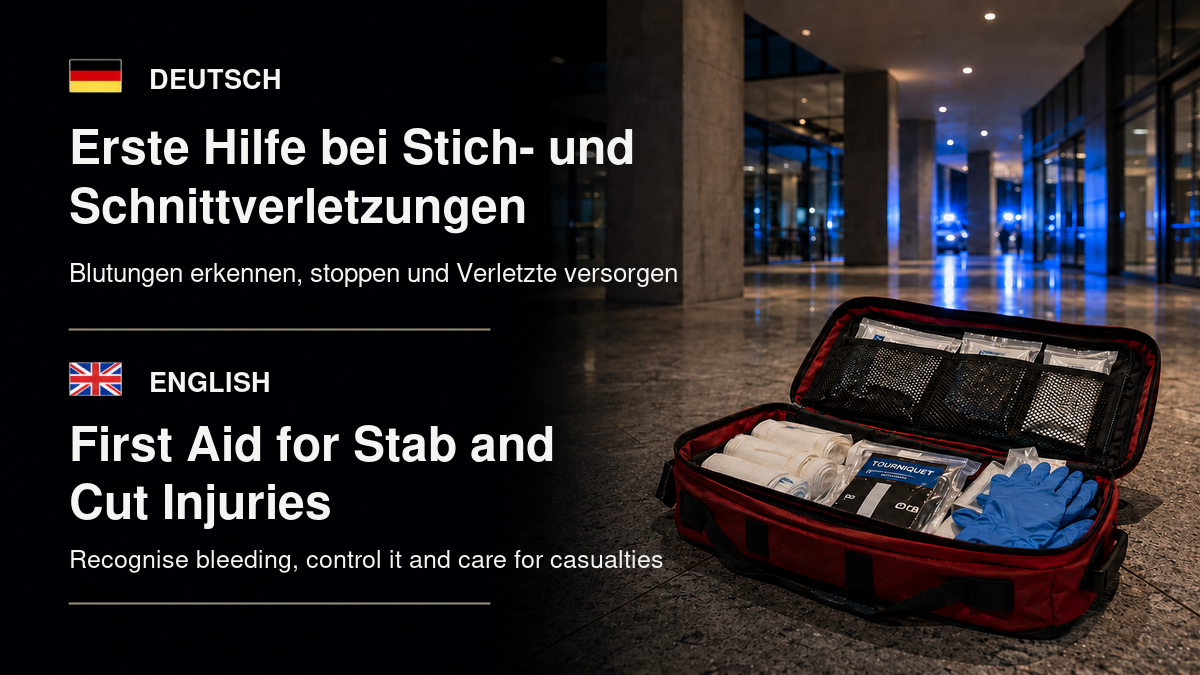
A bleeding-control kit may contain disposable gloves, eye protection, robust trauma dressings, compressed gauze, approved haemostatic dressings, appropriate tourniquets, an emergency blanket and trauma shears. Its contents must match the risk, staff competence and emergency response chain. Equipment alone does not create safety. It must be easy to find, clearly marked, protected against tampering, checked regularly and genuinely accessible during exercises. Tourniquets and haemostatic products belong only within a system that includes training and refresher practice.
Exercises should focus on dependable processes rather than dramatic staging: confirmation that the area is safe, allocation of tasks, retrieval of equipment, communication in noise, treatment of a concealed wound and handover to arriving crews. Afterwards, review delays, handling errors and equipment problems. The aim is not tactical overconfidence but a short and reproducible chain of survival.
The central message
With stab and cut injuries, the decisive factor is not the most dramatic intervention but the correct priority. Effective care can begin only when the location is safe. The emergency call and determined bleeding control follow. Direct pressure is the standard first measure; wound packing and haemostatic dressings extend it at suitable sites. A tourniquet is used only for life-threatening bleeding from a limb and must be tightened until the bleeding actually stops. Open chest wounds, exposed abdominal organs and embedded objects require different measures.
No small skin opening should be allowed to conceal the potential depth of a penetrating injury. A first aider who continuously monitors bleeding, breathing, responsiveness and temperature, reports changes clearly and prepares an ordered handover provides defensible and effective care. Organisations cannot replace this capability by purchasing equipment. It develops through risk assessment, accessible resources, hands-on instruction and repeated practice.
Sources and guidelines
- Resuscitation Council UK: First Aid Guidelines 2025 – life-threatening bleeding and open chest wounds
- Resuscitation Council UK: Adult Basic Life Support Guidelines 2025
- German Resuscitation Council: 2025 Resuscitation Guidelines – concise German edition
- ANZCOR Guideline 9.1.1: First Aid for Management of Bleeding
- German Red Cross: Bleeding and haemorrhage control
- DGUV Information 204-007: First Aid Manual
- DGUV Information 204-022: First Aid in the Workplace
- Robert Koch Institute: Tetanus guidance and post-exposure measures
- AWMF: S3 Guideline on the Treatment of Patients with Severe and Multiple Injuries, version 4.1
- American Red Cross: First Aid for an Abdominal Injury