The hotel is still standing. Your passport is in your pocket. But the road to the airport is blocked, the evacuation transport has not arrived, and nobody can reliably say who controls the next checkpoint. Isolation can begin in the middle of a crowd, when familiar connections no longer provide protection.
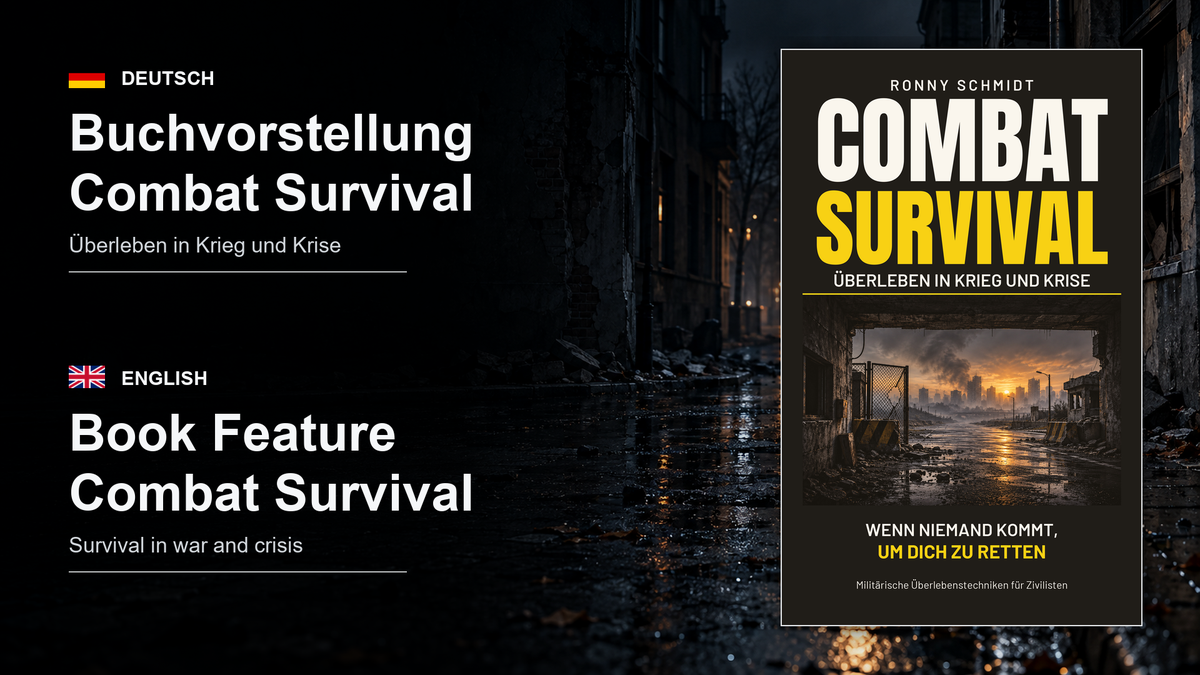
This is the situation at the heart of Ronny Schmidt’s Engllsh-language handbook Combat Survival: Surviving War and Crisis. Military Survival Skills for Civilians. It is written around the circumstances of an individual, unarmed civilian without dependable support. Across 23 chapters, Schmidt follows the progression from the initial loss of control through essential needs and evasion to arrival in a place that genuinely offers protection.
When familiar survival principles need reassessment
The book begins by changing the context of familiar skills. After an accident, making yourself visible may help rescuers find you. In hostile surroundings, the same signals may attract people you need to avoid. Fire provides warmth but also draws attention. A road offers direction and potentially unwanted contact. Even a suitable resting place must be assessed in terms of how it can be left again.
Schmidt draws on principles from Combat Survival and SERE, adapting them to civilian circumstances. SERE stands for Survival, Evasion, Resistance and Escape. The book considers preserving life, avoiding threats and enduring coercion, with a return to dependable protection as the purpose of each decision.
Assessing the situation therefore receives substantial attention. What has actually been observed, and what has merely been repeated? Is a possible route within the limits of the person’s remaining strength? Would movement, a temporary retreat or contact with an identifiable source of help improve the position? Rumours, identity documents and the loss of belongings are all part of this practical assessment.
Physical needs and the ability to judge
Concealment, temporary hiding places and the assessment of possible pursuit are discussed alongside physical limitations. Moving slowly takes time. Wet clothing increases heat loss. Lack of sleep affects perception. Schmidt treats these as interacting pressures that influence every subsequent choice.
Chapters on essential needs cover water, protection from cold and wet conditions, food and medical self-care. The full cost of an activity matters: a potential food source must be reachable without disproportionate effort and usable under the circumstances. A minor foot injury can become more consequential for the next stage of a journey than a missing item of equipment. The book draws attention to these easily overlooked dependencies.
Illustrations, comparison tables and recurring reminders help organise the material. The starting point is what a person actually has left: clothing, footwear, the contents of their pockets and their existing knowledge. Readers interested in personal safety will find a sustained examination of how available choices change with physical condition and surroundings.
Survival includes the return
The chapters on captivity, questioning and psychological pressure give the handbook further depth. They address the preservation of identity and daily structure when someone else controls the person’s movements. Later chapters consider the approach to secured areas. Making contact with potential rescuers, communicating useful information and obtaining medical care are treated as distinct challenges.
Drawing on his background as a paratrooper and his work as a survival and personal protection trainer, Schmidt addresses readers who want to examine crisis preparation in greater depth, including those considering overseas travel or work assignments. Combat Survival asks readers to engage with difficult trade-offs. It provides a framework for understanding individual techniques through a persistent, practical question: under these conditions, what will help a person take the next achievable step?
Book details
- Author: Ronny Schmidt
- Title: Combat Survival
- Subtitle: Surviving War and Crisis: Military Survival Skills for Civilians
- Language: English
- Paperback: 251 pages
- Publication date: 06 Oktober 2026
- ISBN-13: 979-8160604169
View the English-language paperback on Amazon
About the author: Ronny Schmidt