Friday, 12:41 p.m.
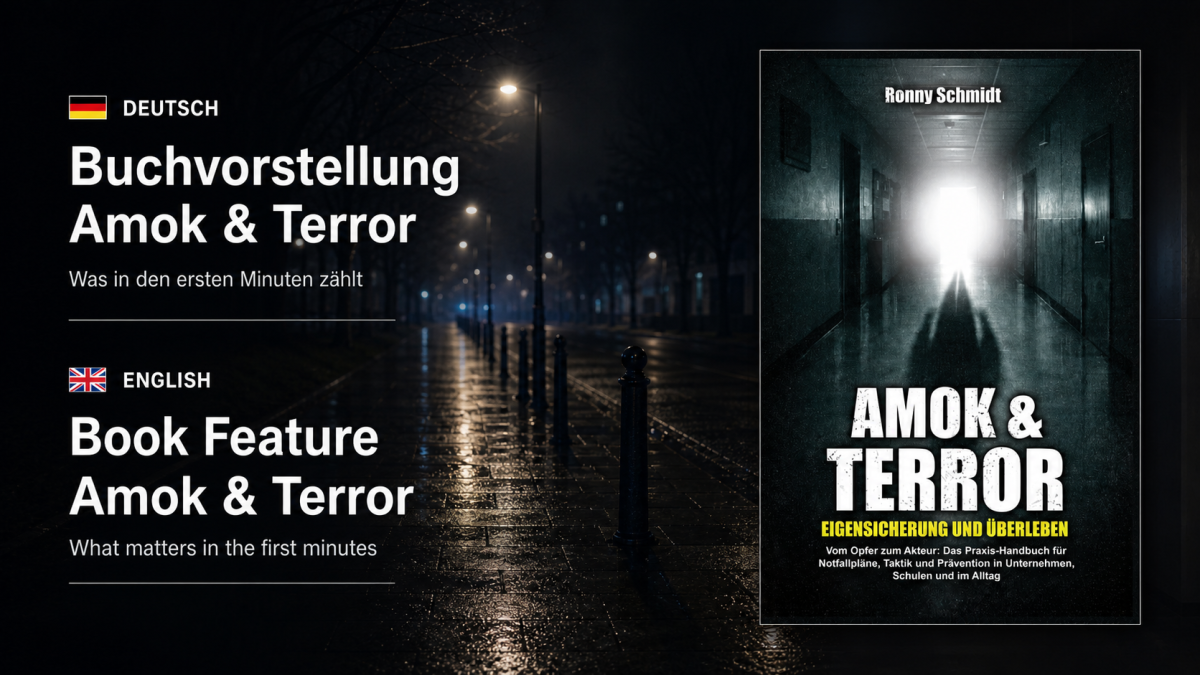
Amok & Terror: Eigensicherung und Überleben opens in the middle of a shopping mall. Conversations stop, glass shatters, and a stroller gets caught in a doorway. Then three shots are fired. Within seconds, an ordinary summer day has turned into an emergency that nobody inside the building can fully understand.
The book focuses on these first few minutes. What can people do while emergency services have not yet reached them and reliable information is unavailable? How can they make decisions when noise, fear, and conflicting movements make orientation difficult? The answer is not a single technique, nor a promise of complete safety. The book develops a coherent system that connects awareness, movement, the use of space, communication, and preparation.
Run, Hide, and Fight are only the starting point. The three familiar response options become a practical framework for individuals, businesses, schools, and other institutions. It begins long before an attack, with the question of how attention can be managed and decisions prepared. It does not end with the first escape attempt or the closing of a door, but continues through casualty care, group organization, and cooperation with arriving emergency services.
Becoming capable of action before stress takes over
An acute attack affects people not only physically, but first through their perception. Loud bangs are mistaken for fireworks, screams for an argument, and frantic movement for harmless commotion. The brain tries to fit the unfamiliar into familiar patterns. This normalcy bias costs valuable time because the threat is initially explained away instead of acted upon.
The book therefore begins with mental preparation. It explains why the OODA loop, originally developed in a military context, can be too demanding for unprepared civilians during the immediate response phase. Observe, orient, decide, and act sounds logical as an orderly sequence. Under extreme stress, however, orientation itself can become the obstacle: too much information has to be assessed just as the ability to analyze it begins to decline. Trying to establish a complete picture of the situation first can result in paralysis.
As a more practical foundation for everyday use, the book applies the Cooper Color Code. White represents inattention and severe distraction, Yellow a calm awareness of the surroundings, Orange a specific concern, and Red immediate action. The color code is not intended to create a permanent state of alarm. It works as a regulator for attention. Someone who notices a concern early can form a simple if-then decision while still in Orange instead of postponing the decision until the pressure to act is at its highest.
This leads into mental scripting. Entering a building does not require designing a complicated emergency plan in your head. A quick look for a secondary exit, a solid source of protection, and the next sensible route is enough. These observations create small pre-planned transitions: if the main door is blocked, use the stairs to the left; if an escape route ends, move to the next room that can be locked. Decisions made in advance reduce the need to search for an entirely new solution during the emergency.
Run, Hide, Fight – and what comes next
The three response options are not treated as a rigid sequence. A situation can change within seconds. An exit that was initially clear may become blocked, a protected room may lose its safety, or movement may suddenly provide a way out of a direct confrontation. The key is not to choose Run, Hide, or Fight once and remain committed to it, but to prepare for the transition to the next sensible action.
Run means more than simply moving away as quickly as possible. The book divides escape into reachable sections and explains how building corners, pillars, side corridors, stairways, and doors can be used to break lines of sight. The next protected position matters more than an ideal route that exists only on a floor plan. Doorways are treated as dangerous bottlenecks: anyone who stops, looks back, or waits for others in the frame blocks the route and remains exposed. The sequence is deliberately simple – move through, step to the side of the doorway, and only then reassess the situation.
Hide does not begin with simply crouching behind a piece of furniture. The first step is to understand which way a door opens, where force acts on the lock and frame, and where a barrier must actually make contact. An inward-opening door requires a different solution from one that opens outward. At the same time, a barricade must not prevent the people inside from leaving later if evacuation becomes possible.
Position inside the room also requires closer consideration. The area directly opposite the door is the first part visible when it opens. The book describes this area as the Fatal Funnel and contrasts it with the Hard Corner on the same wall as the doorway. This changes the way apparently safe positions are evaluated. The rear wall is not automatically protected, a large desk is not automatically cover, and a closed car door cannot be compared with the solid mass around the engine block and axle. Concealment blocks the view, but it does not necessarily stop physical force or projectiles.
The book also addresses details that are rarely included in brief general guidance. In a dark room, a smartphone can illuminate a person's face and make it clearly visible. Smartwatches activate when the wrist moves, displays and indicator lights reveal positions, and light-colored clothing or reflective objects strengthen a person's outline. Hiding therefore becomes an active process: make access more difficult, move out of direct lines of sight, control light and noise, and prepare another option.
Fight remains the last resort in an inescapable close-range confrontation. Resistance is not presented as a duel, and complicated disarming techniques are not treated as a reliable standard. The objective is to disrupt the attacker long enough to create distance or reopen an escape route. Once separation becomes possible, the purpose of resistance has been achieved. What happens afterward is equally important: objects must be put down, hands kept visible, and instructions from arriving police followed immediately so that those defending themselves are not mistaken for another threat.
For this reason, the book expands Run, Hide, and Fight into the 3-plus-1 principle. The additional element is Consolidation. In a temporarily protected area, people are gathered, casualties located, responsibilities assigned, and information prepared for the emergency call. A disorganized group is difficult to assess and can create further risks. An organized group can provide information, administer first aid, and give arriving emergency services a clearer picture of the situation.
Turning individual responses into a workable emergency plan
An emergency plan cannot work only on paper. Escape routes, doors, stairwells, windows, lighting, and communication equipment have to be examined in the actual building. A heavy cabinet is of little use if it cannot be moved. A door provides no protection if it cannot be locked. A designated route loses its value if it is obstructed in daily use or leads into an exposed assembly area. The book therefore combines personal response measures with a practical assessment of the property.
For the period after the first protective action, it defines four clearly separated roles. Red takes responsibility for the door and security, Blue for communication and the emergency call, Green for casualty care, and Yellow for coordinating the group. These duties are not linked to rank or workplace hierarchy. Whoever is capable of acting and accepts a task assumes that function for the duration of the emergency.
To ensure that these roles are not merely remembered but actually carried out under stress, the book places Action Cards directly where each task has to be performed. The red card is positioned at the door, the blue card at the communication equipment, the green card with the emergency medical supplies, and the yellow card at a central location. Short actions in a fixed order replace the search for the next decision. This form of cognitive offloading – transferring mental processes to a visible aid – turns an abstract plan into equipment that can be used immediately inside the building.
Training that remains accessible in an emergency
Knowledge alone does not create the ability to act. The training described in the book therefore does not begin with a large-scale active-attack exercise, but with short sessions lasting from a few seconds to several minutes. A door is closed, locked, and checked at the handle. When entering a room, the three-point scan identifies a secondary exit, the most solid source of protection, and the location of an emergency card. Two people practice an unambiguous danger signal that triggers immediate movement without a lengthy discussion.
These micro-drills develop individual motor, cognitive, and communication skills before combining them. Only then are scenarios introduced, following a clear structure: briefing, trigger, action, controlled conclusion, and immediate debriefing. This makes it possible to identify what actually worked and where the process broke down. The purpose of the training is not to stage the most dramatic possible event, but to build practical skills that can be assessed and improved.
Because rarely used abilities deteriorate, the book treats preparedness as a continuous process. A year-long training cycle progresses from examining the building and becoming familiar with available equipment to practicing roles, procedures, and eventually exercises with increasing levels of distraction. Short repetitions can be integrated into the working day and counter skills fade without regularly disrupting the organization with large exercises.
When standard recommendations are not enough
The conditions inside a shopping mall differ from those at an isolated worksite, a school, or a multistory office building. The book therefore applies its basic system to a range of environments. In public places, it addresses crowd movement, alternative exits, dark rooms, and the transitional areas between a building, a parking lot, and a vehicle. For lone workers, access control and redundant communication become more important. The PACE model defines a primary communication method, an alternate method, a contingency option, and an emergency channel so that a single smartphone does not carry the entire connection to outside help.
Another focus is placed on people for whom standard recommendations cannot be applied without modification. A wheelchair user may be unable to use an escape route involving stairs, a deaf person may not hear a siren, and a purely visual alarm does not help a blind person find the way. The book therefore addresses measures including Defend-in-Place in a preselected protected area, the two-sense principle for alarm systems, buddy systems, nonverbal picture cards, and evacuation routes that are genuinely accessible. Inclusion becomes a testable part of security planning instead of a general statement of intent.
The legal limits of physical resistance are not ignored. A dedicated section explains self-defense, defense of others, and other legal justifications under German law. Historical case studies covering Virginia Tech, the Thalys train, the Bataclan, the attack on the synagogue in Halle, and the Olympia shopping center in Munich then examine how decisions, physical surroundings, and individual actions affected real emergencies. The purpose of these cases is not dramatization, but to identify recurring patterns that can inform preparation.
Who this book is written for
Amok & Terror: Eigensicherung und Überleben is intended for people who do not want to wait until an emergency to consider what they should do next. This includes individuals as well as those responsible for businesses, schools, social institutions, and isolated workplaces. The book offers no guarantee and does not demand constant fear of an exceptional event. It shows which decisions can be prepared, which weaknesses in a building can be identified, and which simple procedures can be practiced regularly.
Its practical scope extends from personal awareness to an emergency plan for an entire property. Action Cards and an inspection checklist in the appendix make it possible to apply the principles to specific rooms and responsibilities. The result is not a general appeal to be more careful, but a practical handbook for personal safety, prevention, and organized action during the first minutes of an acute attack.
Book details
- Author: Ronny Schmidt
- Title: Amok & Terror: Eigensicherung und Überleben
- Subtitle: Vom Opfer zum Akteur: Das Praxis-Handbuch für Notfallpläne, Taktik und Prävention in Unternehmen, Schulen und im Alltag
- Language: German
- Paperback: 118 pages
- Publication date: December 14, 2025
- ISBN-13: 979-8278747635
View Amok & Terror
The product page lists the currently available formats, price, and delivery information.